
The Past, Present, Future Tarot Spread: How to Read It
How to read the Past, Present, Future tarot spread: what each position means, good questions to ask, a full worked example and three useful variations.
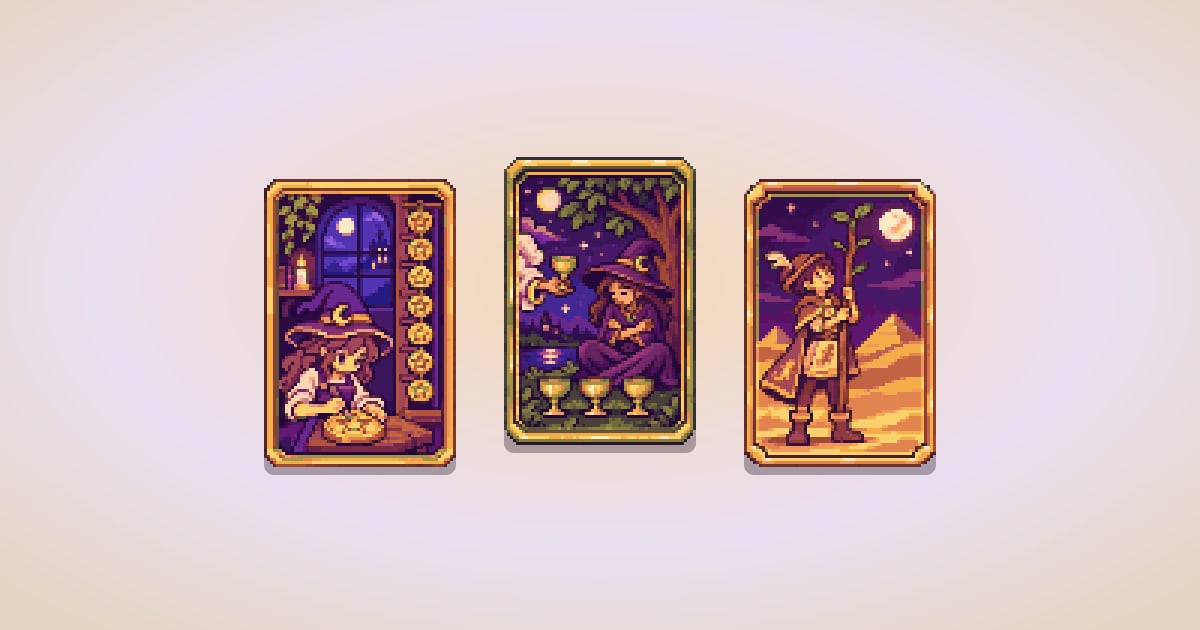
If tarot had a starter recipe, this would be it. Three cards, laid from left to right, telling one small story about a situation in your life.
The Past, Present, Future spread is simple enough to learn in an evening and deep enough that experienced readers keep coming back to it. This guide covers the three positions, the questions that suit it, a full worked example, and a few ways to adapt it.
Why three cards work so well
One card gives you a snapshot. Ten cards can feel like a crowded room. Three cards sit in between: enough to show movement, few enough to hold in your head at once.
A story needs a beginning, a middle and a direction, and that is exactly what this layout offers. Instead of asking "What does this card mean?", you start asking "How did I get here, and where is this going?"
That shift, from single meanings to a flowing story, is the moment many people feel they are truly reading tarot for the first time.
The three positions
Lay the cards from left to right.
- Past (left). What shaped the situation and still echoes in it. Not your whole history, only the part that matters for this question. It might be an old habit, a decision, a relationship, or a mood that has lingered.
- Present (middle). Where you stand now, and the energy around you. This is often the card that feels most familiar, sometimes uncomfortably so.
- Future (right). Where things are heading if the path stays as it is. This is the most misunderstood position. It is not a fixed fate. Think of it as the direction the current is flowing. If you like where it points, keep going. If you do not, the present card often shows where to steer.
That last point matters. The future card is most helpful when you read it as advice: "Given all this, what is the next chapter asking of me?"
Questions that fit, and ones that do not
This spread loves questions about a situation that has a history and is still unfolding.
Questions that work well:
- "What is going on with my energy at work?"
- "How has my friendship with Sam changed, and where is it heading?"
- "What do I need to understand about my move to a new city?"
- "Why do I keep putting off my creative project?"
Questions that work less well:
- "Will I get married this year?" A yes or no about the future leaves the past and present cards with nothing to do.
- "What is my ex thinking?" Tarot reflects your side of a story and cannot read another person's mind. For matters of the heart, the love spread is a better fit, and this guide on reading tarot for love explains why.
- "Should I take job A or job B?" Two clear options suit a layout with two paths, like the decision spread.
A worked example: "Why have I lost my spark at work?"
Meet Maya, a graphic designer who has been in the same role for four years. She is not unhappy exactly, but every Monday feels grey. She shuffles with her question in mind and draws three cards.
Past: Eight of Pentacles. A craftsman sits at his bench, carefully carving a coin, with finished coins displayed on a post beside him. This is a card of dedication and skill built through steady repetition. For Maya, it describes her first years in the job: learning, improving, taking pride in her craft. That growth is real, and it is still part of her.
Present: Four of Cups. A young man sits under a tree with his arms crossed, staring at three cups on the grass. A hand reaches out of a cloud offering a fourth cup, and he does not seem to notice it. The keywords are apathy, contemplation and missed offers. This is the grey Monday feeling exactly. The interesting detail is that offered cup. Something is being held out, and the card asks whether she has become too withdrawn to see it.
Future: Page of Wands. A young figure in a bright tunic holds a tall, sprouting staff and studies it with open curiosity. Pages are students, and Wands are fire. This card speaks of enthusiasm for something new, a message about an adventure, the itch to explore.
Now weave them together. Say the story out loud, one card at a time:
"I built real skill by doing the same work with care (Eight of Pentacles). That repetition, which once helped me grow, has gone flat, and I have stopped noticing what is on offer (Four of Cups). If I let myself be curious again, a new spark is waiting, most likely as a beginner at something (Page of Wands)."
Look at how the cards answer each other. The Eight of Pentacles and the Four of Cups both show a figure focused on objects in front of him, but the first is absorbed and the second has checked out. The suits move from earth (practical work) to water (feelings) to fire (energy). The story travels from doing, to feeling, to wanting.
The court card in the future position adds one more layer. A Page is a learner, not a master. The next chapter may ask Maya to be a student again.
So what might she actually do? The reading does not tell her to leave her job. It nudges her to look for the "fourth cup": a side project, a class, a new kind of brief, a colleague with an idea she has brushed aside. Small, curious steps, the kind a Page would take.
Variations on three cards
The beauty of a three-card layout is that you can rename the positions to suit your question.
- Situation, Action, Outcome. The first card shows what is happening, the second what you could do, the third where that action may lead. Lovely for practical problems. With Maya's cards, the Four of Cups in the action spot would read differently: stepping back to reflect is fine, but staying there too long is the trap.
- Mind, Body, Spirit. A check-in with yourself rather than a situation. The first card reflects your thoughts, the second your physical energy and daily rhythms, the third your sense of meaning. Read the body card as a reflection on rest and habits, never as a health reading.
- Keep, Release, Begin. Handy at a birthday, a new year or any fresh chapter: what to hold on to, what to let go of, and what to start.
Tips for a clearer reading
- Read the middle card first if you get stuck. The present is usually the easiest to recognise, and it gives you a foothold for the other two.
- Find the hinge. Most three-card stories have a turning point. Look for the card where the mood changes.
- Let reversals soften, not frighten. A reversed future card may show energy that is delayed or turned inward. A reversed Death in that spot often points to a fear of letting something end, not to a disaster.
- Write the one-sentence story. If you cannot sum up the reading in a sentence, you have not found the thread yet. Look again at the suits and numbers.
- Revisit it in a month. Read your notes back and see which card made the most sense in hindsight.
To practise with a real draw, try the free tarot reading, or build your card vocabulary with a daily one card spread. New to the deck altogether? The beginner's guide to reading tarot cards covers the basics first.
Try it with your own cards
Ask a question and draw a free reading in your browser.
Keep reading
-
 Learn TarotHow to Read Tarot Cards: A Beginner's GuideLearn to read tarot step by step: the 78-card deck, the four suits, asking a good question, shuffling, reversals and a first practice exercise.
-
 Love & RelationshipsHow to Read Tarot for Love and RelationshipsA kind, honest guide to love tarot: better questions, the cards most tied to romance, readings for singles, couples and after a breakup, plus a spread.
-
 Self-DiscoveryTarot Journaling: 30 Prompts for Self-DiscoveryThirty tarot journaling prompts for beginnings, emotions, relationships, work, shadow and endings, plus a simple daily habit and a monthly review.