
How to Read Tarot Cards: A Beginner's Guide
Learn to read tarot step by step: the 78-card deck, the four suits, asking a good question, shuffling, reversals and a first practice exercise.
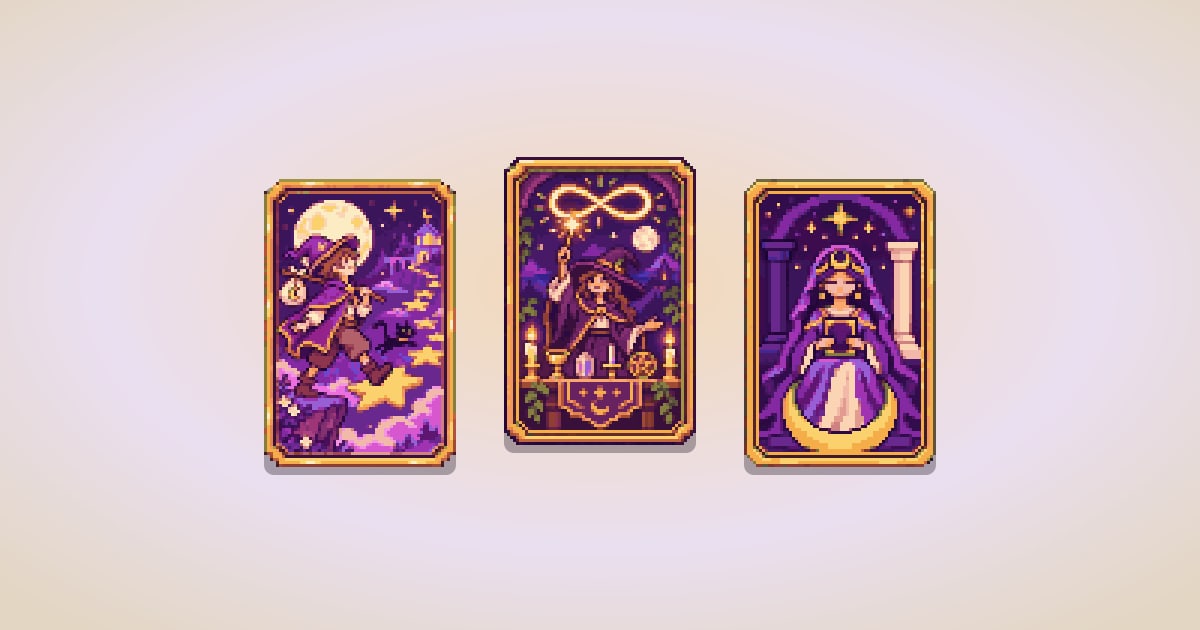
Plenty of people open their first deck and feel lost within ten minutes: seventy-eight cards, strange pictures, and meanings that seem to contradict each other.
Here is the good news: reading tarot is less about memorising and more about looking. This guide walks through the deck, the small ritual of asking and shuffling, how to read one card, and an exercise to try tonight.
Think of tarot as a mirror, not a crystal ball. The cards do not tell you what must happen. They give you pictures to think with, and the thinking is where the value lies.
Meet the deck: 78 cards, two families
A traditional deck, like the Rider-Waite-Smith deck most beginners learn on, has 78 cards in two groups.
The Major Arcana are 22 cards numbered 0 to 21, from The Fool to The World. These are the big themes of a life: beginnings, love, change, hope, endings. When a Major card appears, it often points to something larger than a passing mood.
The Minor Arcana are 56 cards about everyday life. They come in four suits, each linked to an element:
- Wands (fire): energy, drive, creativity and ambition. Think of the Ace of Wands, a hand offering a sprouting branch.
- Cups (water): feelings, love, friendship and intuition.
- Swords (air): thoughts, words, decisions and conflict.
- Pentacles (earth): work, money, home and practical things.
Each suit has ten numbered cards, Ace to Ten, plus four court cards. The numbers tell a small story of their own: Aces are seeds, Fives are struggles, Tens are a cycle reaching its end.
The courts can be read as people or as ways of being. Pages learn and explore, Knights act and chase, Queens nurture from within, and Kings lead outwardly.
You do not need to memorise any of this before you start. Knowing the four suits already gives you a rough feel for 56 cards, and you can browse every card any time in the card meanings library.
Before you draw: a question and a shuffle
A reading begins with a question, and the shape of that question matters a lot.
Closed questions like "Will he text me?" or "Will I get the job?" ask the cards to predict, and they leave you with nothing to do. Open questions invite reflection and give you something to work with:
- "What do I need to understand about this new job?"
- "How can I show up better for my friend right now?"
- "What is keeping me from finishing my project?"
Notice that good questions usually have "I" in them. Tarot is at its best when it looks at your own choices and feelings.
Then shuffle in whatever way feels comfortable. Shuffle overhand like playing cards, or swirl the deck face down on the table. Stop when it feels done or after a set count. Neither is more correct. While you shuffle, hold the question loosely in mind, then cut the deck or simply take cards from the top.
Lay the cards out in a spread, a pattern where each position has a job. Start small. The one card spread is perfect for daily practice, and the Past, Present, Future spread is the classic first step into reading several cards at once.
Reading a single card in three steps
When a card turns over, resist the urge to grab the booklet. Try these three steps, in this order.
- Look at the picture. Who is there? What are they doing? What is the weather, the colour, the mood? Give it a full minute.
- Add the keywords. Now check the traditional meaning. Often the picture has already told you most of it.
- Place it in its position. Ask what this card means in this spot, for this question.
Take The Magician. One hand points up to the sky, the other down to the earth. On the table in front of him lie a cup, a sword, a wand and a coin: one object for each suit. Before reading a single keyword, you might guess "he has everything he needs". The traditional keywords agree: willpower, skill, focus, turning ideas into something real.
Now put him in a position. As the present card in a question about a stalled side project, he may be saying the tools are already on your table. The question shifts from "Can I do this?" to "What am I waiting for?"
Compare him with the card that follows, The High Priestess. She sits still between a dark pillar and a light one, a scroll half hidden in her lap. Where the Magician acts, she listens. Seeing the two side by side teaches more than any list: one is outward doing, the other is inward knowing.
Reversals, without the fear
Sometimes a card lands upside down. This is called a reversal. Reading reversals is optional, and plenty of experienced readers read every card upright.
If you do use them, let go of the idea that reversed means "bad". A reversed card often shows the same energy blocked, turned inward, delayed, or just beginning to shift.
The reversed Three of Swords, for example, is often read as heartbreak starting to heal. The reversed Fool can point to a leap held back out of fear, which is a very human and very useful thing to notice.
A good beginner habit: read the upright meaning first, then ask, "What would this look like if the energy were stuck, quieter, or pointing inward?"
When cards talk to each other
Once you lay more than one card, the real reading lives in the connections. A few things to notice:
- Suits. Three Cups in a question about work may hint that feelings, not tasks, are the real topic. A crowd of Swords can point to overthinking.
- Majors. Several Major Arcana cards in a small spread can suggest a meaningful chapter rather than a passing week.
- Numbers. Two Aces may point to fresh starts on more than one front. Several Tens can show things wrapping up.
- Gaze and movement. Figures face left or right. Does someone in one card seem to look toward, or away from, another?
Try to say the whole reading as one sentence before you go deeper. For example: "Something new is starting, I have the tools, and I need to trust my quieter instincts about it." That sentence is your reading. The details just colour it in.
Five beginner mistakes, and gentler habits
- Asking the same question again and again. If you dislike an answer, sit with it for a day instead of drawing again.
- Reading from fear. Death almost never means a literal death; it speaks of endings that make room for something new. The Tower is upheaval that clears away what was false. Look a card up before you panic.
- Treating the booklet as the only truth. Your own reaction to the picture counts too.
- Letting the cards decide for you. Tarot can light up your options, but the choice stays yours. For health, legal or money questions, a qualified professional is the right person to ask.
- Never writing anything down. Which leads to the most useful habit of all.
Keep a simple journal: the date, your question, the cards, your first impression, and one line a few days later about what you noticed. Patterns appear surprisingly fast. If that appeals, these 30 tarot journaling prompts are a gentle place to begin.
Your first practice: the kitchen-table exercise
Here is a ten-minute exercise for tonight.
- Take out three cards you have never studied, and do not look up their meanings.
- For each card, write down three things you see and one feeling it gives you.
- Make up a single sentence that links all three, as if they were panels in a comic strip.
- Only now look up the meanings and compare. Circle anything you guessed close to right.
Most beginners are surprised by how much the pictures alone told them. Repeat this a few times a week and the deck starts to feel less like a code and more like a conversation.
When you want to try a full reading with the positions already laid out, the free tarot reading lets you draw cards in your browser and practise these same steps. Start small, stay curious, and let the cards be a mirror for your own thinking.
Try it with your own cards
Ask a question and draw a free reading in your browser.
Keep reading
-
 Love & RelationshipsHow to Read Tarot for Love and RelationshipsA kind, honest guide to love tarot: better questions, the cards most tied to romance, readings for singles, couples and after a breakup, plus a spread.
-
 Self-DiscoveryTarot Journaling: 30 Prompts for Self-DiscoveryThirty tarot journaling prompts for beginnings, emotions, relationships, work, shadow and endings, plus a simple daily habit and a monthly review.
-
 Tarot SpreadsThe Past, Present, Future Tarot Spread: How to Read ItHow to read the Past, Present, Future tarot spread: what each position means, good questions to ask, a full worked example and three useful variations.